-
24-02-2024
Neue music zeitung (NMZ)-Germany about "Natures" CD
"David Chaillou, is today one of the finest French composers. The concept album “Natures” describes an aestheticized daily routine, alternating between music for string quartet, solo cello, piano and percussion (twice atmospherically combined with nature sounds such as bird calls from the tape). Whether cellist Christophe Pantillon has to play tremolo, sul tasto, pizzicato or quite normal, whether pianist Laura Mikkola plucks the grand piano or plays the keys the keys doesn't matter musically: the minor-key introverted, minimalist introverted, minimalistically saturated, structurally ascetic soundscapes are landscapes of sound are precisely formed, evocative in expression and immediately catch the ear. All pieces are in one movement. The main work is the quartet “Vita Nova” from 2021, which can hold its own wonderfully alongside Pärt, Vasks or Kancheli can hold their own. The Aron Quartet's playing is sparkling clean. An album with cult potential, especially the pizzicato “Hieroglyphics” for cello cello, which ends with a surprising bowed note." Christoph Schlüren
-
01-09-2024
Textura-Canada
" the fifty-four-minute release is worthy of attention, not only for the music itself but for the fact that its ten pieces, all world premiere recordings, receive stellar treatments from a distinguished cast of musicians. That includes Finnish pianist Laura Mikkola (who recorded Chaillou's first monographic album, 2020's Légendes), Aron Quartett, the group's cellist Christophe Pantillon, and percussionists Morgan Laplace Mermoud and Pierre Tomassi. All boast impressive CVs, with the quartet's prize-winning box set of Arnold Schönberg's string quartet works, for example, regarded by some as one of the finest chamber music recordings of the previous century.
Changes of instrumentation occur throughout the recording, but it's held together by a unifying concept having to with the temporal trajectory of a single day. While it opens with Aron Quartett's wide-eyed rendering of Vita Nova, it concludes with the hushed stillness of Barque. In between are the events of an imagined day with all the variety that entails. When bird sounds (culled from the sound library of the Paris Natural History Museum) seep into the musical presentation, one visualizes the album's so-called “solitary walker” stepping outside to commune with nature. Generally speaking, however, Natures retreats from being too referential; instead, the Paris-based composer prefers to keep his material allusive, impressionistic, and amenable to interpretation, even when a title might point in a specific direction.
At sixteen minutes, Vita Nova (2021) casts a towering shadow, not only for its duration but for its titanic character. The work invites comparison to Arvo Pärt's Fratres for sharing its haunting quality and its insistence. Strings flutter, swoop, arc, and criss-cross aggressively throughout, though Chaillou judiciously counters high-intensity passages with comparatively peaceful ones. Aron Quartett delivers a scintillating performance that others would be hard pressed to match. Certainly any string quartet in search of a terrific piece to add to its concert repertoire need look no further than Chaillou's mesmerizing creation. In its other performance, an angst reminiscent of Shostakovich permeates Aron Quartett's impassioned reading of Gulf stream (1998). Fittingly, Laura Mikkola, who studied at the Sibelius Academy in Helsinki (as well as at the Curtis Institute of Music and Bloomington University in the United States), performs Au piano de Sibelius (2020), the first of many pieces on which she appears. Adding to its impact, Mikkola's wordless voice appears alongside the piano during the work's spectral centre, the music otherwise oceanic in its swells of rolling clusters. In Désert (2022), she plucks the instrument's strings and floods the background with an almost subliminal reverberation. Amidst those aforementioned bird twitters and calls, the pianist's sprinkles and the percussionists' accents conjure shadowy mystery in Forêt (2022). Playing both the inside and outside of the piano, Mikkola partners with Mermoud and Tomassi a second time for the closing meditation Barque (2022). Similar to Mikkola, Pantillon makes repeated solo appearances, the searing introspective journey that is L'oiseau (2021) first, the alternately plaintive and feverish Solo (2018) second, and the pizzicati-dominated Hieroglyphs (2022) third. The authority of his attack and his impressive technical command and emotional expression make for riveting solo performances. In addition to Pantillon's artful bowing, an arsenal of techniques is utilized, from harmonics, tremolo, and double-stops to glissandos and percussive effects.
Natures earns its recommendation on the strength of both its writing and performances. It's tempting to single out Vita Nova as the album's standout, but the others have much to recommend them too; the considerably shorter Gulf stream, for instance, is no less memorable than that opening string quartet piece. Close listening reveals the release to be a special one that's very much worthy of attention."September 2024
-
Revue Esprit-France
"You slip into it in the morning like Alice down the rabbit hole." Following his album Légendes, French composer David Chaillou's second monographic album stands out brilliantly, balancing construction and dazzling intensity, woody soundscapes, and carnal colorism. Natures is a labor of love, the beguiling voluptuousness of a reverie that sheds new light on the nocturnal face of liminal lyricism — Gérard Grisey at his finest. The first piece, Vita Nova, is an arrow of time in music that introduces a climate of bold ease. A free-flowing freshness emerges. The harmony sharpens, revealing the features of a demanding yet free melody whose sparkle breaks the metric structure. Then, Sibelius's piano operates in the weave of its voluble arpeggios, correcting harmonic appetites in favor of the slenderness of the timbre. We can see this again in Désert and Barque, for birds and keyboard. Its trills respond to the barcarolles of Perrault's or Grimm's forests. Childhood and nature itself are now enchanted by artifice, which alone holds the keys to the kingdom of enchantment. David Chaillou is well aware of this and broadens the concept of French music without denying it. He does not renounce the elegance of harmonic and rhythmic means, the beauty of form, or the virtuosity of composition. These ten or so pieces have a purity of transcendence and lucid objectivity that defend against exhibitionism. Consider the architectural sense, the shared attention to chiaroscuro and complexion, and the summoning of the flesh in the analytical arrangement. Even before chiseling angles, curves, contours, and colors, the initial chaos must be found through directions and lines of composition. Curiously, one is reminded of Paul Klee's dolls, which he used to theorize the extraction of sound or pictorial lines from chaos — a concept that Deleuze and Guattari drew from for ritornello" Paloma Hermina Hidalgo 2024. https://esprit.presse.fr/actualite-des-livres/paloma-hermina-hidalgo/natures-de-david-chaillou-45363
-
24-02-2024
Classykeo-France
Natures, by David Chaillou: The reveries of a solitary stroller?
‘
Natures, by the composer David Chaillou, is a dreamlike and fantastical stroll through the day of a contemporary composer. It is a blend of melancholy reverie, romantic aspiration, attentive listening and faithful friendships. (...) The introspective and contemplative aspect of the album reaches its climax with the piece Desert. Performed by Laura Mikkola directly on the piano strings, with the strings left free to vibrate thanks to a pedal block, its gentle telluric slowness is quite magnetic. Listening to this disc gives a strange feeling of inner purification, which seems to detoxify us from the turmoil and hectic pace of the outside world. To be listened to again and again without moderation! Claire de Castellane.
The wole article :
https://www.classykeo.com/2024/06/10/natures-de-david-chaillou-reveries-dun-promeneur-solitaire/
-
02-06-2024
France Musique (National radio) about Natures CD
A stroll through nature, David Chaillou offers his visions of nature through pieces for piano, quartet, and cello...
https://www.radiofrance.fr/francemusique/podcasts/en-pistes-contemporains/balade-en-pleine-nature-1224259
-
08-05-2024
Musique classique & Co-France about "Natures" CD
Elegant, refined music with magnificent tones
Christophe Pantillon, meanwhile, performs three pieces for solo cello: L'oiseau, Solo (already published by Cascavelle) and Hieroglyphs. These pieces are of such high quality that they should appeal to many cellists. " Thierry Vagne
https://vagnethierry.fr/tag/david-chaillou/
-
01-07-2024
Le littéraire.com-France about "Natures" CD
Where is our secret home?
With Natures, David Chaillou, a composer born in 1971 and trained at the Paris Conservatory and the Sorbonne, offers us his second monographic recording after Légendes. His work is part of the legacy of French composers such as Henri Dutilleux and Gérard Grisey, as well as the post-minimalist movement. Here, he invites the listener to wander ─ (the album cover features a photograph of a green path that one imagines leading to an unknown forest) like a solitary walker through time and space, evoking the secrets of nature.
Bernard Grasset
The whole article :
https://www.lelitteraire.com/?s=David+chaillou
-
22-05-2024
Südwest Presse-Germany
The compositions of Frenchman David Chaillou (*1971) combine the musical tradition of his homeland with elements of post-minimalism and open up fascinating listening spaces. The title of Chaillou's new album “Natures” says it all. Each of its ten movements sketches very different natural landscapes and forms a self-contained cycle" Burkhard Schäfer
Review + interview
-
02-10-2024
Mediapart-France about "Natures" CD
-
31-08-2020
American record guide-USA about Légendes CD
"His music is psychological in nature, finding the most expression in the contrasts between movement and stasis, space and the lack thereof. Chaillou's skill is in the distortion and transformation of these qualities, guiding the listener along a progression of emotion and sensations. This is virtuosic music of pure sound, with the piano conjuring cascades, shimmers, or ethereal glows in a language that is comfortably, if fluidly tonal. He is a conscious impressionist, naming Ravel and Dutilleux among his influences, as well as spectralism and minimalism. If you have interest in any of these styles, you will enjoy Chaillou's music." Nathan Faro.
-
17-11-2020
Radio BRF 1-Belgium sur "Légendes" CD
-
30-05-2020
RAI3-Suite-Italy
-
11-05-2020
Piano-News-Germany about "Légendes" CD
note : ⭐️⭐️⭐️⭐️⭐️⭐️ repertoire⭐️⭐️⭐️⭐️⭐️⭐️ (maximum note) interpretation
"In fact, this floating, highly fragile, self-listening music captivates from the first note. But this musical language is not spun and hermetic, its gesture is rather narrative. To paraphrase the sociologist Hartmut Rosa, it seeks resonance, focuses on world relations and thus literally creates a free space. The pianist Laura Mikkola hits the - for all its internationality - very French idiom of Chaillou's sound language so convincingly that one gets downright addicted to this CD." B.S.
-
18-02-2020
YLE-National-Finnish Radio (Helsinki) abour "Légendes" CD
-
26-10-2020
The New-Listener-Germany
-
17-05-2020
France Musique : En piste contemporains
-
05-03-2020
Radio RBB-Kultur Berlin about "Légendes" CD
Radio RBB-Kultur Berlin- ⭐️⭐️⭐️⭐️⭐️(maximum note). " A spiritual space".
For Légendes. "A modem Impressionism" and ""a modern minimalist approach". "The result is a transparent lightness of sound. A very dynamic music that rarely stops at a chord, but on the contrary is always in motion (...) '. " A spiritual space". Hans Ackermann
https://www.rbb-online.de/rbbkultur/themen/musik/rezensionen/cd/2020/03/david-chaillou-legendes.html
-
17-03-2020
Francis Wolff, philosopher. Author of “Pourquoi la musique?” (Fayard)
” There is in “Légendes” a very subtle blend of scholarly writing and (false) improvisation that gives the impression of wandering. A thousand miles away from jazz writing (no syncopation, swing, rhythmic ostinato, blues mode, etc.), there is nevertheless something that evokes jazz's avoidance of melody in favor of motivic exploration and, once again, the idea of solitary walks. But here we are far from the nocturnal jungle of cities, closer to morning landscapes with uncertain moods.
What strikes me most about this writing is the rejection of any narcissistic insistence (we never linger on a musical idea, we encounter it in passing, we don't return to it, we don't repeat it), and therefore the assumed rejection of any complacency. Among the most obvious successes in my view are “Empreintes,” “Diableries,” which is very clever and devious, and “Voix parallèles.” Francis Wolff.
-
27-03-2020
Mediapart-France about "Légendes" CD
"Music of today, this score combines the contributions of the twentieth century with the desire for melody." "A discovery ".
Frédéric Casadessus
-
15-06-2019
Hufvudstadsbladet -Finlande-Helsinki
“(...) Les mains nues is a fascinating work with its blend of impressionism and minimalism (...). The combination of lyrical and expressive qualities is particularly evident in the third movement (Qui parle là-bas?) and the rich use of the pedal gives the music a much-needed sense of space in the rather dry acoustics of the cruciform church. The pieces in Les mains nues are short, like miniatures, but with Mirages, which had its premiere, and Diableries, a powerfully sonorous and rhythmically demanding piece that closes the work, they form a brilliant whole of piano music for the 21st century (…)." Wilhelm Qvist
-
18-06-2019
The Kouvolan Sanomat (Finland)
"THE PIANO WORKS CHARMED
"In the concert the piano works of the French composer David Chaillou rose up as absolute pearls. His works now got their premiers in Finland. Laura Mikkola`s technical and artistic brilliance created huge spatial and three-dimensional visions, which were astounding in their virtuosity. The rhythmical twist of the third work was deeply felt even within the bodily insides. A fantastic artistic whole!good in the concert: The magnificent premiers of David Chaillou´s piano works.
Päivi Stenvall
"The works of David Chaillou played by Laura Mikkola were the highlights of the evening. Chaillou had succeed to create masterly sonorous piano texts of the somewhat familiar-sounding elements. Laura Mikkola´s performance was a sheer diamond, she was a transcendent virtuoso and an excellent creator of music.Good in the concert: Laura Mikkola´s brilliant pianism.Special in the concert: The premiers of Chaillou´s piano works and the presence of the composer at the concert."Jukka Kainulainen
Translation : Pirkko Pingoud and Olli Pasila.
-
31-10-2017
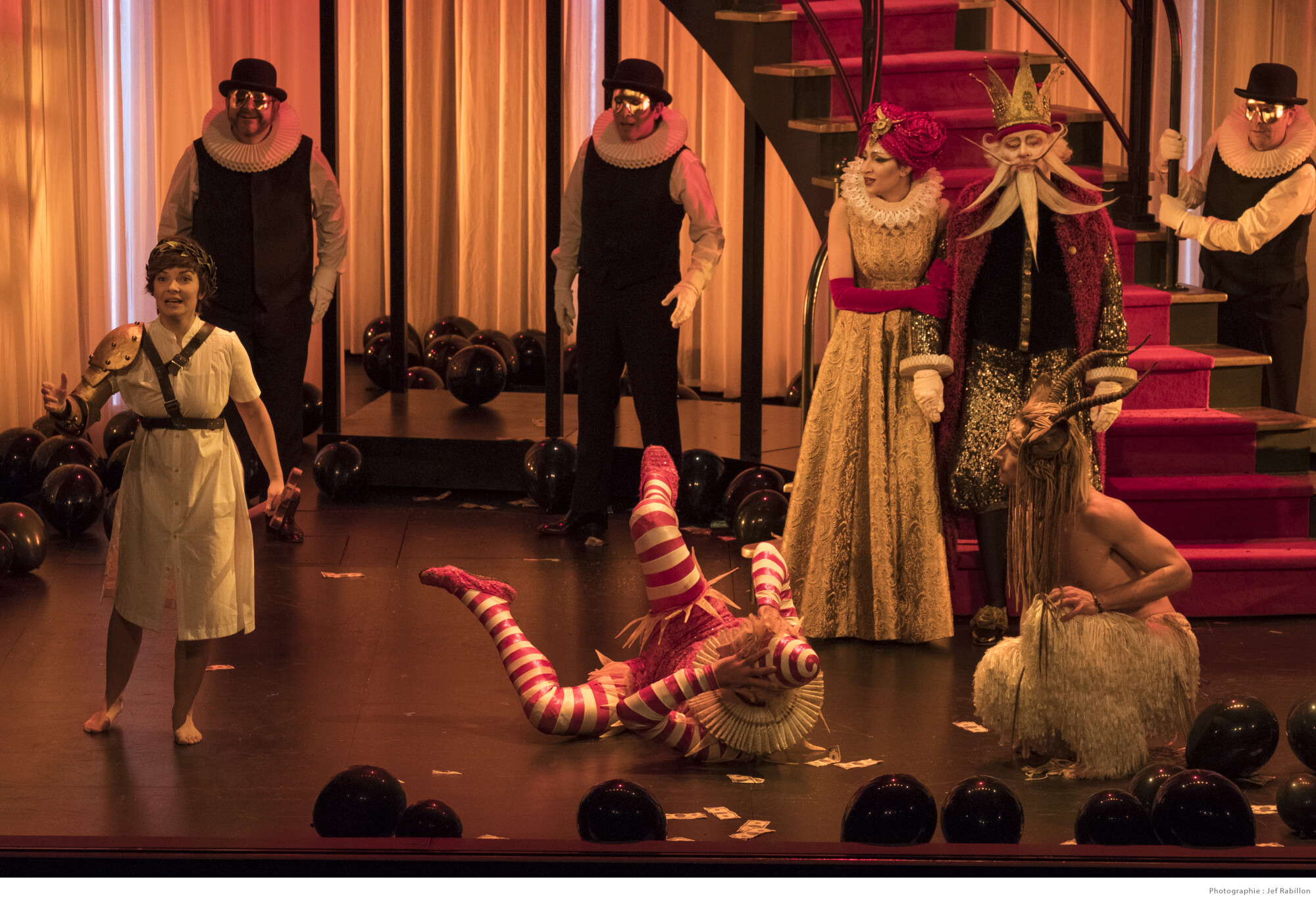
L'Obs: Little Nemo, from enchanted dreams to musical dreams
"Magical, enchanting, joyful, and infinitely poetic. Vibrant and bursting with life, colors, and fairy-tale images. Rich in magnificent costumes. Performed by spellbound artists, singers, dancers, actors, and musicians. Words abound to describe this 'opera for all,' this 'Little Nemo,' inspired by the dreamlike stories of Winsor McCay." David Chaillou's colorful, seductive, and surprising musical composition, dominated by piano and percussion, energizes a visually surprising show." —Raphaël de Gubernatis
-
04-02-2017
Télérama: Little Nemo, opera for all ages (FFF)
On Wednesday, January 18, the charming Théâtre Graslin in Nantes buzzed like a birdcage. Children and adults came to discover Little Nemo, a lyrical reverie based on Winsor McCay's legendary comic strip. Fascinated as a child by this dreamlike (and wonderfully graphic) universe, composer David Chaillou reinvented it in notes and sounds through a captivating score. Performed by an 11-piece chamber orchestra, with piano and percussion playing a prominent role, mixed with electronics, the music plays on a multiplicity of styles and uses (narration, commentary, atmosphere creation, etc.), and the voices constantly change from spoken to sung. Sophie Bourdais
-
20-01-2017
La Croix: Little Nemo — an enchanting opera.
This lyrical creation by Angers-Nantes Opéra, for adults and children, invites the audience
to preserve or rediscover their childhood. (...)David Chaillou's musical composition, performed with energy by the Ars Nova ensemble, is perfectly in tune with the finely crafted writing of this modern tale, alternating between a wide variety of registers and rhythms, from Mozartian accents to electro tones (...). To share this hymn to waking dreams, the cultural program surrounding the show—with more than 5,000 children—is ambitious. Florence Pagneux
-
27-03-2017
La lettre du musicien : Little Nemo, from comic strip to stage
Created in January at the Théâtre Graslin in Nantes, David Chaillou's opera Little Nemo was revived a few weeks ago at the Grand-Théâtre in Angers, after a stop in Dijon. The show delighted young and old alike. Opera for children has its own particular codes, repertoire, and masterpieces. But is David Chaillou's Little Nemo one of them? It belongs to a related but rare genre: operas about childhood. Examples include L'Enfant et les Sortilèges. Little Nemo avoids the simplifications generally associated with the genre, both in subject matter and music. Yet the magic works, and children of all ages seem to enjoy it. David Chaillou's music fits this baroque tale surprisingly well. The singers utilize all the capabilities of the voice, incorporating speech, Sprechgesang, recitative, arioso, and virtuoso arias. The extremely mobile orchestral writing, entrusted to the ten musicians of the Ars Nova ensemble conducted by Philippe Nahon, covers a vast polystylistic field. It borrows from repetitive music, the shimmering tones of French Impressionism, and Stravinsky's rhythms in the style of Les Noces or Le Renard. It even occasionally uses electroacoustic sounds, yet never gives the impression of disparity."
-
23-01-2017
Le Figaro: Little Nemo, the opera that is enchanting the world
“In Nantes, composer David Chaillou has created a successful and dreamlike adaptation of Winsor McCay's cult comic strip. The Ravelian shimmerings of the piano and percussion accompanying Nemo's flight evoke memories of these fantastical and tender worlds.” Thierry Hillériteau
-
17-01-2017
Diapason : Little Nemo de David Chaillou, rêve d'enfant pour tout public
David Chaillou (born 1971) was captivated as a child by the dreamlike world of Little Nemo in Slumberland, the classic comic strip by American artist Winsor McCay. A pioneering work for its freedom of tone and style, it was published between 1905 and 1914. A century and some stardust later, the French composer brought the comic strip to the opera stage in Nantes. Librettists Olivier Balazuc and Arnaud Delalande took up the story of the boy invited by King Morpheus to join the 'Land of Sleep' ('Slumberland') and his daughter, the princess. They introduced an adult Nemo: an unscrupulous speculator who, upon returning to his childhood home, rediscovers the fantasies of his former dreams and finds new purpose in life. A story for young and old alike, David Chaillou's writing covers a range of styles and moods, from scholarly to popular and playful to dreamy. Benoît Fauchet says that he "has the merit of leaving no listener behind".Benoît Fauchet.
-
13-04-2016
France Musique, on Les Mains nues, for piano
“Pianist Moises Fernandez Via's album is built around three personalities, including contemporary composer David Chaillou. His piece Les mains nues is a beautiful piece of music that makes use of the instrument's resonance. An album of great poetry, to be placed alongside the purest and most introspective works. A wonderful discovery and a personal favorite.” France-musique, En piste program
-
27-01-2016
BR Klassik (radio, Munich, Germany), on Les Mains nues for piano
“The last piece on this disc is by French composer David Chaillou, written especially for the CD. The music of this third Parisian takes its place in an imaginary dialogue between Mompou and Boulanger. A new and different voice. This intermezzo (”Les mains nues“) broadens the horizon of the CD and fits perfectly into the dramaturgy. A beautiful, intelligent CD.”
-
23-09-2015
WDR 3 (Radio Cologne, Germany) Tonart program about les mains nues
"Another bridge between Mompou and Boulanger is provided by contemporary composer David Chaillou. His piece—Les mains nues, which gives the album its title—was created especially for the recording. Although it contains no direct quotations from Mompou or Boulanger, Chaillou explores related soundscapes such as the contrasts between high and low registers that play a major role in Boulanger's works. His piece is weightless and acts as a true intermezzo, inviting the listener to dive in and refresh themselves in a veritable “bath of sound.” Nicholas Tribes
-
20-08-2015
Kronen Zeitung (Austria) : “A total work of art inspires enthusiasm”
About the show Léger au front (Carinthischer Sommer Festival)
" A contemporary work of art thrills audiences at the Congress Center Villach Time and again, Thomas Daniel Schlee's Francophile program has amazed audiences at the Carinthischer Sommer, giving the festival a special touch. However, there have been few occasions when contemporary art has been presented in such a compact, moving and original way as in “Léger au front” on Tuesday at the Congress Center Villach.
In this work, commissioned by the Marne department and the Champagne-Ardenne region, which has already been a success in Vienna, exceptional forces from various artistic genres combine their creative potential to create an extraordinary scenic work of art on the subject of the First World War.
Based on letters written by the painter and soldier Fernand Léger on the French front, they bring to life, according to the idea of sculptor Patrice Alexandre, the life of the soldiers at the front, marked by horror and deprivation. Karl Markovics recited these texts in Villach; the composer provided the musical accompaniment for cello, trumpet, and percussion (Christophe Pantillon, Peter Fliecher, Matthias Lill); at the end, Alexandre used heavy, wet clay to transform the actor into a war memorial.
A monument to bloodshed, silent, but also reminiscent of Léger, representative of Cubism and adept at large-scale sculpture. Standing ovations in the Gottfried von Einem Hall."
Translation: Jürgen Strasser
-
20-08-2015
Klein Zeitung -Austria : “a sensual and immediate collage of texts, music, and sculpture.”.
About Léger au front
It is a sensual and immediate collage of texts, music and sculptures presented under the title 'Léger au front' as part of the Carinthischer Sommer festival at the Villach Congress Centre. Initially, the 33-year-old artist, now a front-line soldier, easily overcomes the 'Boches', but as the mission becomes more challenging, the tone becomes more desperate, the letters become longer, and the cries for help become more urgent. Thanks to his prodigious stage presence, Karl Markovics embodies this growing horror and slow torpor. He begins his performance by reciting letters to the sound of the Marseillaise, then starts a drum roll as he energetically paces the stage, manuscript in hand. However, he becomes exhausted, and the sheets of paper fall to the floor.
The soldier is transformed into a war memorial as Patrice Alexandre begins to wrap Markovics in wet clay, the rhythm of which is set by David Chaillou's music. This drives the text forward with percussion (Matthias Lill), trumpet (Peter Fliecher) and cello (Christophe Pantillon). Not only did the composer and sculptor create the performance, they were also present in Villach. At the end, Karl Markovics is a speechless mud statue—a powerful image in keeping with a gripping text that grabs you by the gut.
-
01-03-2014
“The surprise therefore comes from the only living composer, David Chaillou. Seul is a long, highly expressive monologue. It is a perfect, non-controversial response to those who believe that contemporary music can only be ultra-avant-garde or resolutely ‘neo’. From this point of view, Chaillou follows in the footsteps of Jolivet and Dutilleux in his own way.” Jacques Bonnaure
CD Paroles de Violoncelle,
-
03-10-2013
Today's Zaman / Beethovenfest-Bonn--Germany
"On 2 Oct., French pianist François-Fréderic Guy performed two Beethoven sonatas surrounded with pieces by Debussy and Schoenberg and the world premiere of two compositions specially commissioned for this recital that commemorated the 50-year anniversary of the signing of the Élysée Treaty between Germany and France. Empreintes by David Chaillou and Arpeggiator by Johannes Motschmann ingeniously exploited the piano’s wide spectral compass in ways that felt totally original. Delightfully free of gratuitous effects, they both managed to come up with new languages that were highly expressive. Both pieces are destined to become staples of the piano repertoire." Alexandra Ivanoff
-
France 2 about "Philomène et les ogres"
“No fewer than four godfathers and one godmother were involved in the design and production of this musical tale. Their harmonious teamwork has produced an exciting result. Whether you read it or listen to it, Philomène et les ogres captivates with its language and colors, its inventiveness and its generosity.” Véronique Le jeune.
-
17-12-2011
Res musica on Philomène et les ogres
"Philomène et les Ogres: A must-have! Open the book, listen to the CD, and simply let yourself be transported. The music enriches and adds an extra dimension to the story, in a rare fusion of intelligence and sensitivity. Particularly noteworthy are the choral parts, which are pure, clear, beautifully performed, and composed in a blend of poetry and humor, all of which create an atmosphere or highlight the words of the text. Better than a movie, a cartoon, or even a traditional musical tale, this is an artistic gem that is a must-have for young and old alike." Nila Djadavjee,